Edge AI in Healthcare: How On-Device Diagnostics Are Transforming Medical Devices
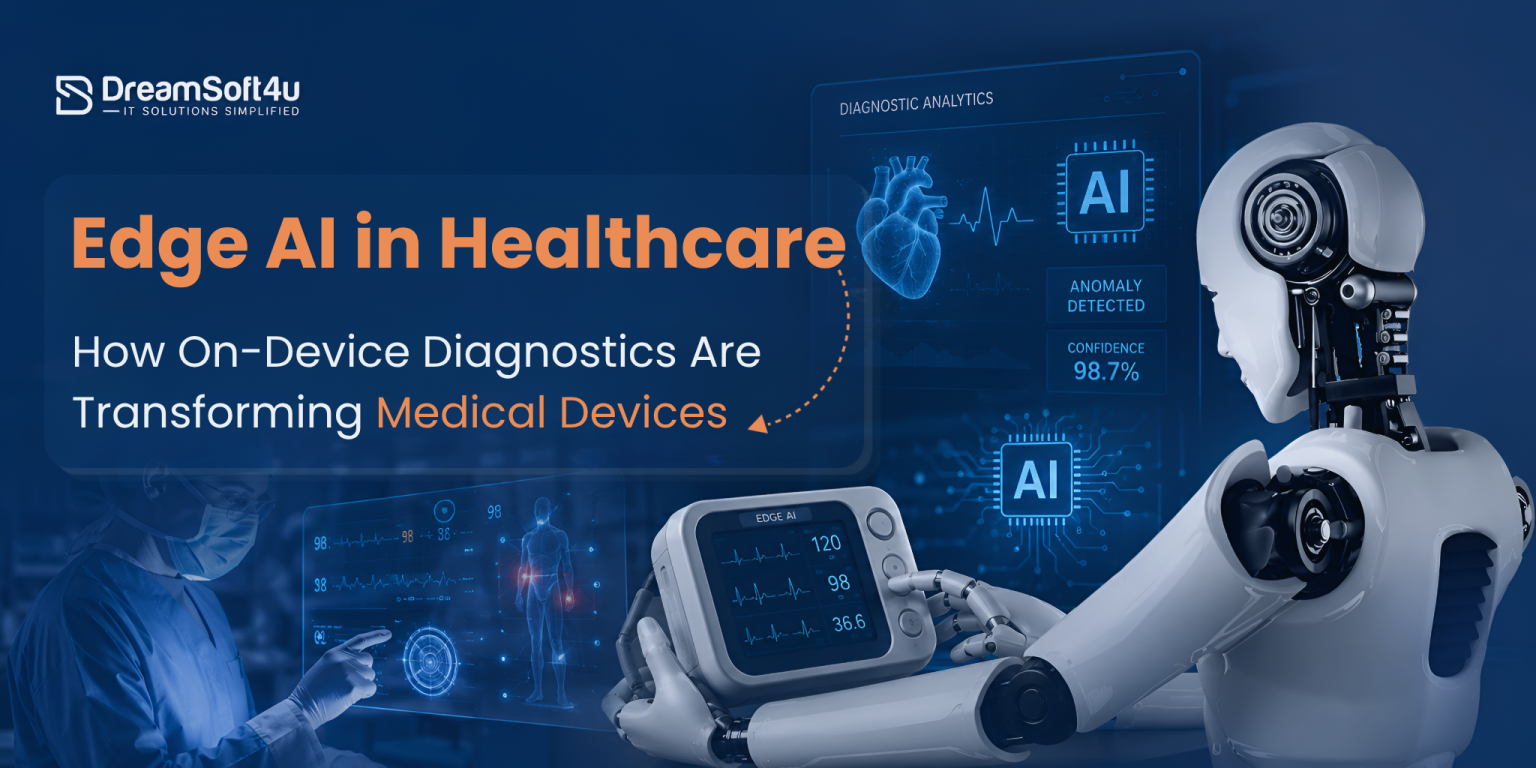
Every second counts in healthcare. Whether it’s detecting a stroke, monitoring a patient’s heart rhythm, or identifying abnormalities in a medical scan, delays in diagnosis can have serious consequences.
Edge AI in Healthcare helps eliminate those delays by bringing artificial intelligence directly to medical devices.
Instead of sending sensitive medical data to the cloud for analysis, Edge AI brings intelligence directly to the device itself. From portable ultrasound machines and wearable ECG monitors to insulin pumps and smart hospital equipment, medical devices are becoming faster, safer, and far more autonomous.
This shift is solving some of healthcare’s biggest challenges. It reduces diagnostic delays, protects patient privacy, lowers dependence on cloud connectivity, and enables high-quality care in ambulances, rural clinics, operating rooms, and even patients’ homes.
For teams investing in healthcare software development, Edge AI is no longer a futuristic concept. It is becoming a competitive advantage for building the next generation of intelligent medical devices.
What Is Edge AI in Healthcare?
Edge AI in Healthcare means a medical device can analyze patient data on its own instead of relying on a cloud server. This allows it to make faster decisions right where the data is generated.
For example, a wearable heart monitor can detect an irregular heartbeat and send an alert within seconds. Since the data is processed on the device itself, there is no waiting for cloud processing, resulting in quicker diagnoses, better privacy, and reliable performance even in areas with poor internet connectivity.
Top 7 Benefits of Edge AI in Healthcare
The benefits of Edge AI in Healthcare reach far beyond speed. The stakes are large too, since AI could deliver net savings of around $360 billion a year in healthcare spending. Here are the seven advantages that push providers and device makers to adopt it.
1. Real-Time Diagnostics and Faster Clinical Decisions
Processing data on the device removes cloud delays, so results arrive in real time. An edge-enabled ECG can catch an arrhythmia the instant it appears. That gives clinicians the head start critical moments demand.
2. Stronger Data Privacy and Compliance
Because analysis happens locally, sensitive records stay on the device instead of crossing public networks. This lowers breach risk and makes it far easier to satisfy HIPAA, GDPR, and similar rules that patients and regulators expect.
3. Reliable Care in Low-Connectivity Settings
Edge devices keep working when the internet does not, which matters in remote clinics and during outages. Care no longer stalls because a signal dropped. That dependability builds trust with staff and patients alike.
4. Lower Bandwidth and Infrastructure Costs
Sending only insights instead of raw data cuts bandwidth use and cloud storage bills. As device fleets grow, that saves compounds. It gives teams a more cost-effective path to scale without heavy backend spend.
5. Continuous, Personalized Patient Monitoring
Wearables and patches track vitals nonstop and adapt to each person’s baseline. This steady stream of on-device insight supports tailored care. It also flags subtle changes long before a scheduled visit would.
6. Reduced Load on Clinicians and Radiologists
Edge models handle first-pass screening and triage, so specialists focus on the complex cases that truly need them. That easing of routine workload helps overstretched teams do more without burning out.
7. Wider Access in Remote and Underserved Regions
By putting diagnostic power into portable, affordable devices, Edge AI reaches places that lack specialists and infrastructure. It widens access to quality care and shortens the distance between a symptom and a sound answer.
7 Common Challenges of Adopting Edge AI in Healthcare (and How to Solve Them)
Adopting Edge AI in Healthcare comes with several technical and operational challenges. The good news is that each challenge has a practical solution. Here are the most common ones.
Challenge 1: Interoperability Across Devices and Systems
Many healthcare devices still use proprietary systems and data formats, making it difficult to exchange information with EHRs, medical imaging systems, and other healthcare platforms.
Solution: Build devices using industry standards like HL7, FHIR, and DICOM. This ensures seamless communication with existing healthcare systems and makes future integrations much easier.
Challenge 2: Hardware, Thermal, and Durability Limits
Edge AI devices must process complex AI models while remaining compact, energy efficient, and durable enough for healthcare environments.
Solution: Choose AI-optimized processors and design efficient cooling systems. Lightweight AI models and purpose-built hardware help maintain performance without overheating or reducing battery life.
Challenge 3: Cybersecurity Across Distributed Devices
Each connected medical device can become a potential entry point for cyberattacks, increasing security risks across healthcare networks.
Solution: Protect every device with strong encryption, secure boot, authentication, and regular over-the-air (OTA) security updates to reduce vulnerabilities.
Challenge 4: Upfront Investment and Integration Complexity
Building Edge AI solutions requires investment in hardware, software, AI development, and integration with existing healthcare infrastructure.
Solution: Start with a phased implementation strategy. Using modular architectures and partnering with an experienced healthcare software development company can reduce costs and implementation risks.
Challenge 5: Data Quality and Model Reliability
AI models are only as accurate as the data used to train them. Incomplete or inconsistent healthcare data can reduce diagnostic accuracy.
Solution: Invest in high-quality data collection, thorough validation, continuous testing, and regular model monitoring to maintain reliable performance.
Challenge 6: Regulatory Approval and Algorithm Transparency
Medical AI solutions must meet strict regulatory requirements, and healthcare providers need to understand how AI reaches its decisions.
Solution: Design products with compliance in mind from the beginning. Document AI decisions, maintain explainability, and work with regulatory authorities early to simplify the approval process.
Challenge 7: Ongoing Model Maintenance and Drift
AI models can become less accurate over time as patient populations, diseases, and clinical practices evolve.
Solution: Continuously monitor model performance, retrain models with updated data, and deploy secure OTA updates to keep devices accurate, reliable, and compliant throughout their lifecycle.
Read Full Article : Edge AI in Healthcare: How On-Device Diagnostics Are Transforming Medical Devices


Medical devices raise the bar considerably above typical edge deployment, since any model change is potentially a regulatory event rather than a routine update, which shapes the entire release process. That makes version control and validation documentation part of the product rather than an afterthought, and firms offering AI Development Services without medical device experience often underestimate how much of the timeline that consumes. On device processing also means accepting a fixed model until the next cleared update, unlike a cloud system that can improve continuously, which is a real trade off for Computer Vision Services running diagnostics locally. Worth having an AI Consulting Company familiar with that pathway scope the AI Integration Services work before anything is built.
ReplyDelete